Medically Reviewed by Dr. Thompson on July 19, 2026
Dental anxiety affects more children than most parents expect, and for some it reaches a point where it stops necessary care from happening at all. We’ve had families come to our practice after years of delayed treatment, where a child’s fear had gone unaddressed at previous offices and what should have been a simple procedure had turned into something more complicated. Sedation changes that. It lets us complete the necessary work comfortably and gives anxious children a positive experience they can actually build on.
At Kool Koala Pediatric and Adolescent Dentistry, we treat sedation dentistry as a clinical tool, not a last resort. Our team evaluates each child individually: what’s the anxiety level, what’s the treatment plan, what’s the medical history, and which option fits all three.
The Children We Most Often See for Sedation Conversations
We notice three consistent patterns in the families who call us about sedation. The first is young children, often preschool age, who were manageable at the first visit and then figured out what’s coming. By visit two or three, we’re working against their memory of the last one. The second group is school-age children who’ve heard something from a sibling, a friend, or a previous dentist who didn’t communicate well — a fear that got planted and hasn’t resolved. The third is children who have had a genuinely difficult experience somewhere else: a procedure that was painful, a provider who wasn’t patient, a first visit that went wrong and colored everything after it.
We get a specific type of call from parents whose children have ASD, ADHD, or sensory processing differences. It usually goes something like: the last appointment ended without completing the work because the sensory environment was too much. The sounds, the suction, the taste of the prophy paste, staying still for 40 minutes. For these kids it’s not fear in the usual sense — it’s that the environment itself is genuinely hard to process. Physical positioning can also be a barrier when it needs to be held for the length of a procedure. Behavioral techniques alone often aren’t enough in these situations, and sedation is what makes the appointment actually completable.
When We Recommend Sedation
Behavior management techniques work for a lot of children: tell-show-do, pacing, distraction, taking breaks. We use them first. Our working threshold is roughly this: if we’ve tried those approaches at multiple appointments and still can’t complete the necessary work safely, we’re having a different conversation with the family. Or if a child’s distress is significant enough that pushing through does more harm to their relationship with dental care than good.
The other conversation comes up when a young child has a lot of work to do — three or four cavities in a child who is two and a half. We can schedule multiple separate appointments and try to build tolerance each time. Or we can do all of it in one visit under sedation and let the child’s next interaction with us be a routine, low-stakes cleaning. In our experience, the second path is better for most of these kids. Parents ask us sometimes: shouldn’t we try without sedation first? Sometimes yes. But we’ve also had cases where repeatedly pushing through over a distressed child’s resistance made future dental care harder, and we try to avoid that.
What a Nitrous Oxide Appointment Looks Like
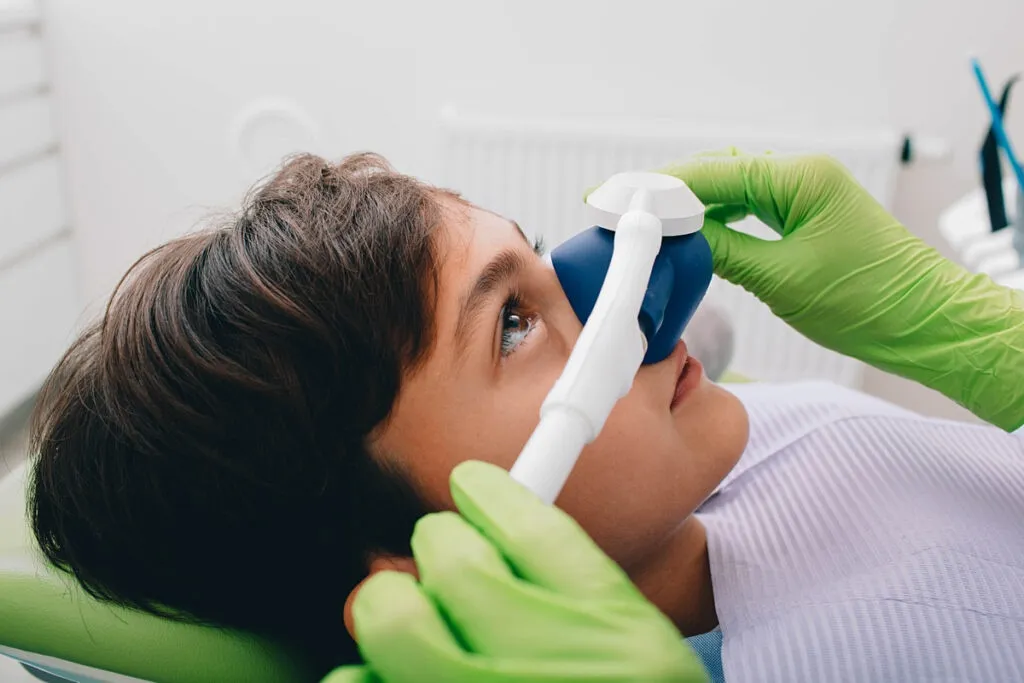
Most of our sedation conversations start here, because nitrous oxide handles the gap between “not quite cooperative” and “able to get through the appointment calmly” for a lot of kids. Here’s what usually happens in the first few minutes. A small mask goes over the child’s nose. The gas has a faint sweet smell that most kids don’t object to. Within two to four minutes, most patients settle. We’ve watched enough of these appointments to know the exact moment it starts working: the shoulders come down, the jaw unclenches. They’re still awake, can still talk to us, can still respond to instructions — they just stop bracing against everything.
We control the delivery throughout the appointment and can adjust as needed. When we’re done, oxygen runs through the mask and clears the gas. They’re themselves again in minutes. No supervised rest at home. No activity restrictions. They can go back to school the same afternoon. And they can eat breakfast before coming in — no dietary restrictions ahead of time.
When We Move to Oral Sedation Instead
For children who need a deeper level of relaxation, or where we’re completing more extensive dental treatment in one appointment, oral sedation is usually the next step. Depending on the protocol, parents either give the medication at home before driving over, or the child takes it when they arrive in our office. Either way, it’s working by the time we’re ready to start — typically 30 to 45 minutes in. What we see as it takes effect: a drowsy, cooperative kid. Still awake, still able to answer us, but more settled than nitrous alone usually reaches. Many have partial or no memory of the appointment afterward.
The recovery is longer than with nitrous. Effects linger for several hours, so children need to go home with a parent and rest. No school that day, no activities requiring coordination or alertness. We send families home with written aftercare instructions and a direct contact number. IV sedation and general anesthesia are also available for more complex situations — we walk families through those options when they’re relevant to a specific child’s case.
What We Watch For During a Sedated Appointment
Before every sedated appointment, we go through the health history directly with the parent. We go over allergies, current medications, anesthesia history. Not a form and a checkbox — a conversation, because we occasionally find something in it that changes the plan.
During treatment, a trained staff member is on vitals the entire time — heart rate, blood pressure, oxygen, breathing — from the moment sedation begins. Reversal medications and emergency equipment are in the room. Every team member who works sedation cases holds current pediatric advanced life support certification. After the procedure, the child stays with us until they meet the discharge criteria, and parents get written instructions for what to watch for at home. Safety protocols for our sedated appointments aren’t a formality — they’re the reason we can offer sedation confidently.
Preparing for the Appointment
Honest, simple language works best when talking to your child. You can tell them the medicine will help them feel sleepy and calm. Skip the procedure details and avoid sharing adult dental experiences that might add to their concern. Comfortable clothing. For nitrous, no special preparation. For oral sedation or deeper levels, we give specific fasting instructions when the appointment is booked — follow them precisely because they’re tied directly to safety.
Some children do well with a pre-appointment visit to see the room and meet the team before the day anything happens. We encourage families to ask about this when anxiety is significant. Good preventive care at routine visits, when anxiety allows for it, also reduces how much treatment is needed down the road — which means fewer situations where sedation is the right call.
What Families Tell Us Afterward
We follow up with families after sedation appointments, and the thing we hear most often is surprise at how uncomplicated the recovery was. Particularly for nitrous cases — parents sometimes expect a long recovery and are back at the car in 20 minutes with a kid who wants lunch. For oral sedation, the recovery takes longer, but what parents notice most is that the child woke up calm and in most cases with no memory of the procedure.
Here’s what we actually see longer-term: children who came to us with significant dental anxiety and, after one or two sedated appointments followed by a few routine visits where things went smoothly, moved on to entirely ordinary checkups without needing sedation again. The goal is to break that cycle — distress leads to avoidance, avoidance leads to worse dental health, worse dental health leads to harder visits. Sedation is the intervention that makes the next visit possible for kids who need it.
Schedule a Consultation at Kool Koala
If your child experiences dental anxiety that has made care difficult, or if they have treatment needs that haven’t been completed, our team can evaluate whether sedation is the right path and which option fits their situation. We see families at our Collingswood, Deptford, Bear, Vineland, Pennsville, and Willingboro offices. Contact us to schedule a consultation.
Frequently Asked Questions About Sedation Dentistry for Kids
At what age can children receive sedation at the dentist?
Age isn’t the deciding factor on its own. The decision is based on the child’s health history, the level of anxiety or cooperation difficulty, the amount and type of treatment needed, and which sedation option is safe for their size and age. Nitrous oxide is used with children as young as three or four when they can tolerate wearing a nasal mask. Oral sedation and deeper levels involve a more careful pre-sedation evaluation, and the clinical picture determines whether a given child is a candidate.
Is nitrous oxide safe for children?
Nitrous oxide has one of the longest safety records of any agent used in pediatric dentistry. Children remain fully conscious throughout. Recovery is immediate once we run oxygen through the mask after the procedure. No fasting is required before the appointment, and there are no aftereffects that would prevent the child from going back to school the same day. It’s not appropriate for all children — some respiratory conditions are contraindications — which is why we complete a health history review before every use.
Will my child remember their appointment after sedation?
It depends on what type of sedation was used. With nitrous oxide, children are fully awake during the appointment and will remember it, usually as something that was calm and not particularly eventful. With oral sedation, many children have partial or no memory of the procedure due to how the medication works. With IV sedation or general anesthesia, children typically wake up with no recollection of what happened. Families who want a specific memory outcome often factor this into which option they choose.
How do I know if my child needs sedation or just better preparation?
Behavioral preparation techniques like tell-show-do and distraction work well for many children with mild anxiety or limited treatment needs. Sedation becomes more appropriate when a child’s anxiety is severe enough to consistently prevent safe treatment, when extensive work needs to be completed in one appointment, when the child is very young and can’t cooperate for longer procedures, or when special healthcare needs make standard behavior management ineffective. A consultation visit is the best way to assess where your child falls — our team looks at the full picture before making a recommendation.
What should my child not eat or drink before a sedated dental appointment?
Fasting requirements depend on the sedation type. Nitrous oxide doesn’t require any fasting. Oral sedation typically requires avoiding solid food for several hours before the appointment, with specific guidance on liquids. IV sedation and general anesthesia have the most restrictive requirements. We provide written pre-appointment instructions specific to your child’s sedation type at the time of scheduling. Following those instructions precisely is important for safety, not just preference. Call our office if anything about the instructions is unclear before the appointment.
About the Author
Dr. Thompson
Kool Koala Pediatric and Adolescent Dentistry
Dr. Thompson is a pediatric dentist at Kool Koala Pediatric and Adolescent Dentistry, with offices in Collingswood, Deptford, Bear, Vineland, Pennsville, and Willingboro. Kool Koala provides sedation dentistry, preventive care, and full-service pediatric and adolescent dental treatment for children from infancy through the teen years.